Herder

For Brett · from Logan

Brett, let’s put every one of your cows on your phone.

Your 100 head across 1,300 acres on a satellite map, and a text the moment one needs you. Collars you own, and software I build and run. Here’s how it works, what it costs, and how we’d find out if it’s worth it.

The demo herd is simulated and moves on the real clock. Yours would be real.

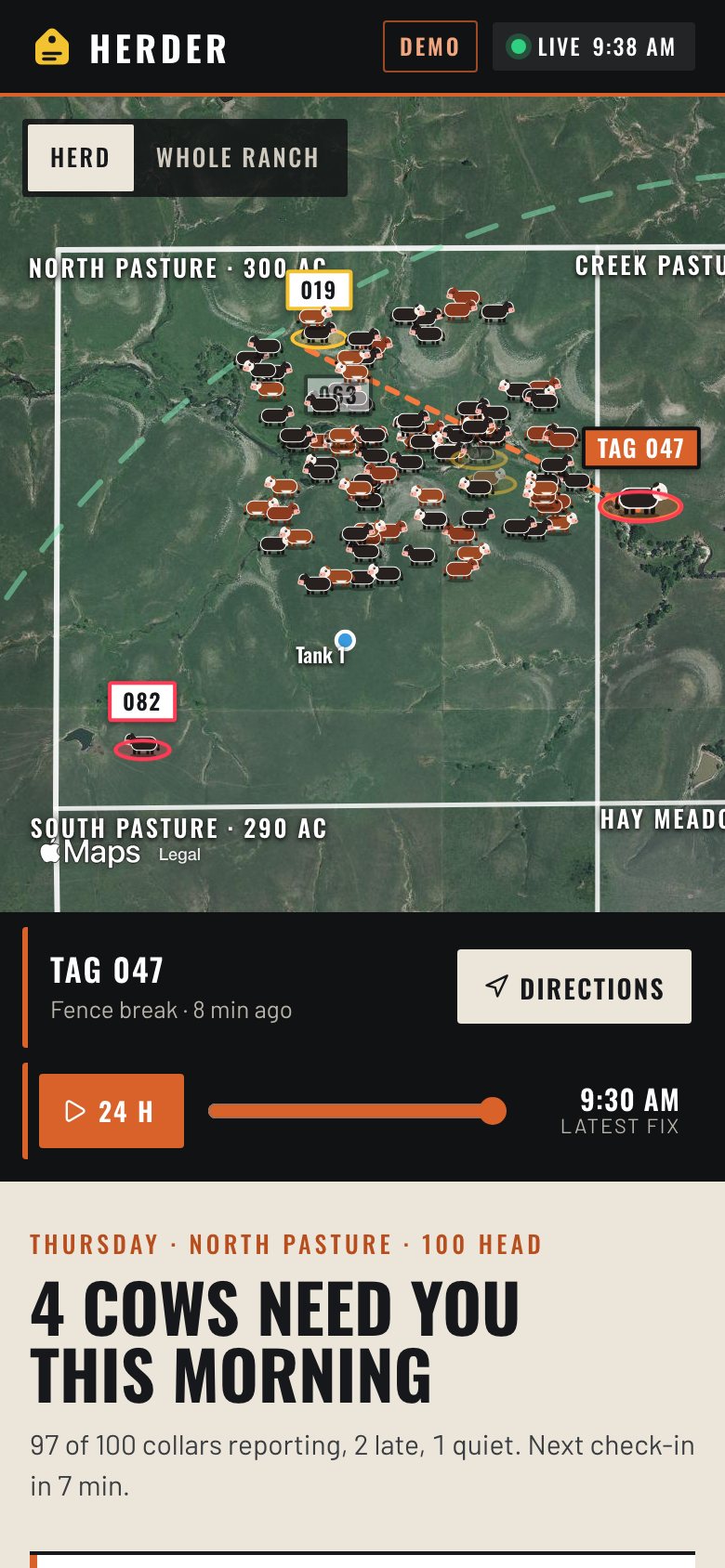
Herder on a phone: a satellite map of North pasture with 100 cows, Tag 047 outside the fence and Tag 082 alone in the corner.
  • 100head
  • 1,300acres
  • 1of you

Your herd today

Brett,

Right now the only way to find the cow that went through a fence, or the one that wandered off to calve, is for somebody to come across her. With 100 head on 1,300 acres, that’s hours or days late.

Here’s what I want to build with you. A GPS collar on each cow, one radio at the barn, and an app on your phone that shows where every one of them is and texts you when one needs you. You’d own the hardware outright. I’d build the software and run it.

The big outfits doing this charge every month, for every cow, and you never own the collars. I think we can do it for a fraction of that. Let’s prove it on ten of your cows first.

Logan

Narduk Enterprises · Acre Oracle
How it works

Three pieces. You don’t need cell service in the pasture.

  1. 1

    A GPS collar on every cow

    Notes where she is every 15 minutes and how much she’s moving. Sealed for mud, water and rubbing posts, on a battery that runs months to a couple of years depending on the collar.

  2. 2

    One gateway at the barn

    A small outdoor radio on a pole hears every collar on LoRaWAN, an open long-range standard. Two gateways should cover 1,300 acres with room to spare.

  3. 3

    Your phone

    The live map, the last day’s replay, and a text when a cow needs you, with one tap to directions.

What you’d see

Tap the alert. The map flies to her.

Every alert says what happened, how long ago, and where. One more tap gives you driving directions to the spot, so you’re not hunting a black cow in a big pasture at dusk.

Try the live demo
  • Her last fix and how fresh it is
  • Her last day: distance walked, time at water, activity
  • Mark her checked once you’ve seen her
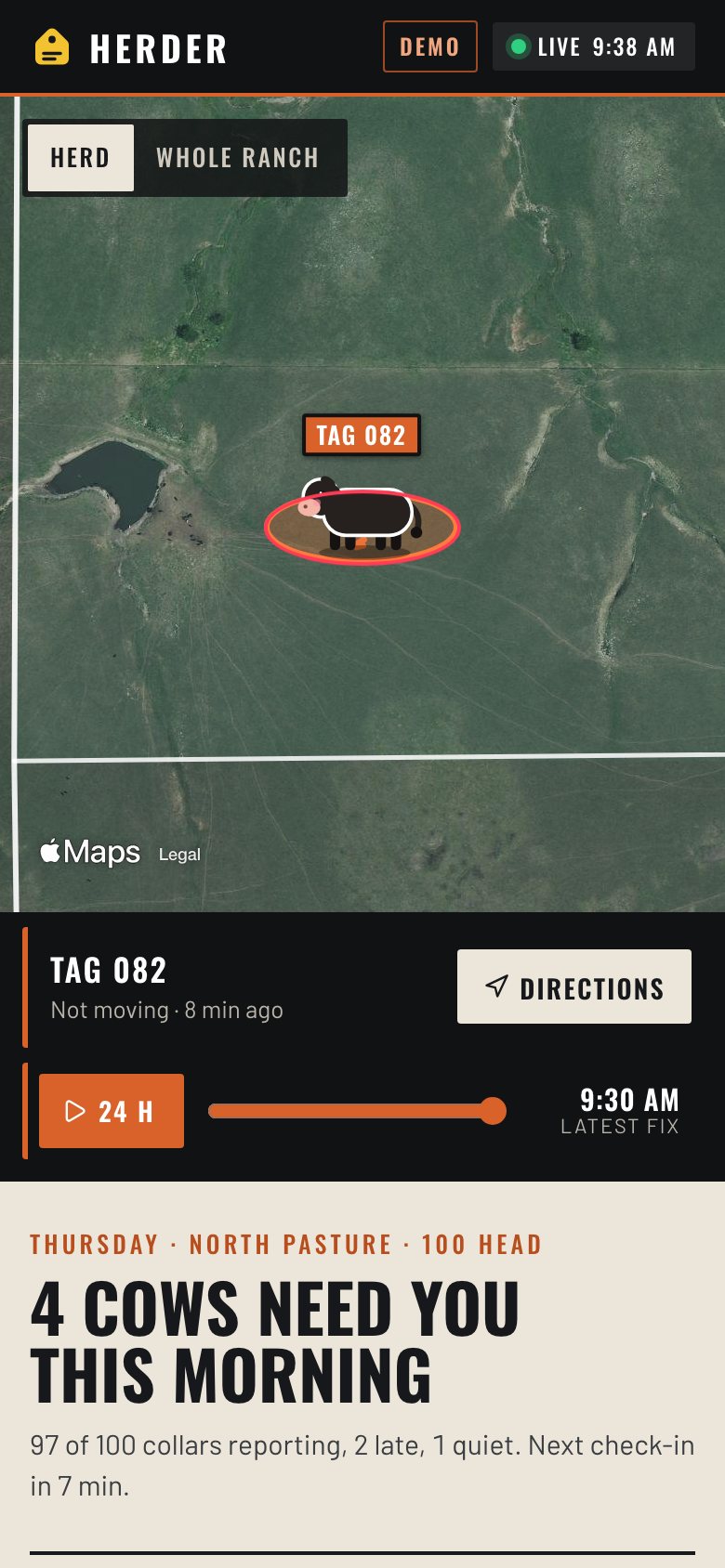
Herder zoomed in on Tag 082 by a pond, with a Directions button.
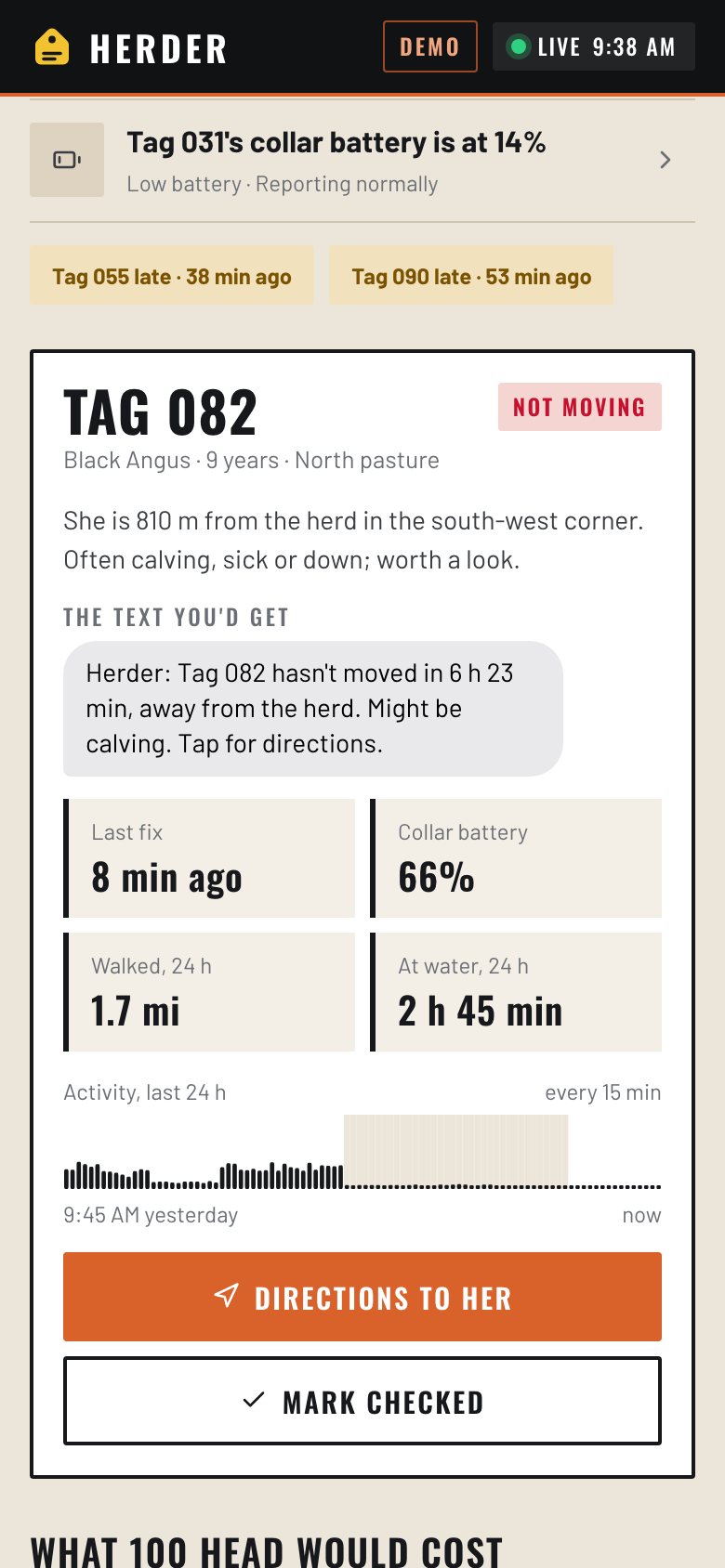
Tag 082's card: not moving, the text alert, last fix, battery, distance walked and Directions to her.

What it watches

The few cows that need you, first.

Ninety-some cows are fine on any given morning. Herder puts the few that aren’t at the top.

  • Fence breaksA cow outside the pasture she belongs in, the moment it happens.
  • Not movingHours without moving, away from the herd. Often calving, sick or down.
  • HeatA restless night while the herd rests usually means she is coming into heat.
  • Quiet collarsShown as quiet, with where she was last heard. Never as “all fine”.
  • WaterTime at each tank, so a cow that stops drinking stands out.
  • Trails and replayWhere each cow has been, and the whole herd’s last 24 hours.

Your numbers

Keep $7k–25k over three years on your 100 head.

That’s against a $5–10 per cow per month subscription. They charge for every cow, every month, and you never own the collars. With Herder you buy the collars and the network once.

≈ $3per cow per month over three years with Herder
$5–10per cow per month on subscription, every month
≈ $30a month to run Herder after setup, for the whole herd

Estimates for 100 head from listed hardware prices (110 collars including spares, 2 outdoor gateways), not a quote. The subscription range is from published pricing. Some subscription products include virtual fencing, which Herder does not.

Why it costs less

Own it once. Run it for pennies.

  • You own the hardwareNo lease, no per-cow fee, no contract to renew. The collars are yours.
  • An open radio standardLoRaWAN gateways and collars come from many makers, so you are never locked to one company’s towers.
  • One network for the whole placeThe gateway that hears the collars also reads soil moisture, water tanks and gates.
  • Built by one person you knowSoftware I write and run myself, priced like it, not like a venture-funded sales machine.

What Herder doesn’t do yet: virtual fencing, which means steering cattle with collar sounds and pulses. It raises animal-welfare and patent questions we want settled before we touch it. Herder starts with knowing where every cow is.

How I’d build it

Proven collars. Our own software.

I don’t make collars, and I don’t need to. Herder runs on GPS trackers that ranchers and fleets already use. You own the hardware. I build and run everything that turns it into answers.

  1. Hardware · you own it

    Off-the-shelf LoRaWAN GPS collars

    LoRaWAN is an open radio standard, so the collars come from established makers and any of them speaks to the same gateway. The pilot runs two makes side by side, and the one that survives your cattle and goes longest between batteries goes on the rest of the herd.

  2. Network · on your place

    One gateway with its own network server

    The gateway at the barn hears every check-in and runs the network server itself, so there's no cloud contract in the middle. It sends each reading to Herder over the barn's internet, or over its own 4G where there is none.

  3. Software · built by us

    Herder

    Each reading reaches Herder within seconds. Herder decodes it, files it under the cow wearing that collar, and checks it against your pastures, her own patterns and the rest of the herd. When something’s wrong, it texts you. It’s what you saw in the demo, with your real herd in it.

  4. Later

    A Herder collar of our own

    Once the pilot shows what your cattle do to collars, I’d design one of our own: solar-charged, so it can check in often without battery swaps. It works on the same network, so nothing you buy now goes to waste.

What you’d buy for the pilot

Everything for 10 cows. You buy it and own it. I set it up with you and run the software.

5×
Digital Matter Oyster3 GPS trackers (LoRaWAN, US915)A proven, sealed tracker (IP68) on replaceable lithium AA cells. We fit it to a cattle collar with a mount we print.Digital Matter dealers
≈ $125–170 each
5×
MOKOSmart LW001-BG PRO GPS trackers (US915)Made for livestock, with a strap. The pilot shows which of the two holds up on your cattle.RFWEL, RobotShop
≈ $78–99 each
5×
Cattle collar straps with counterweightsFor the Oyster3 units. Standard livestock collars from a farm supply store.Farm supply
≈ $15–25 each
1×
SenseCAP M2 LoRaWAN gateway (US915, 4G model if the barn has no internet)Hears every collar and runs its own network server, so there is nothing else to set up. Mount it high in the barn.RobotShop, Seeed
≈ $150–270
1×
Outdoor antenna and cable, if range is shortLifts the antenna above the roofline for the far corners.Any LoRa supplier
≈ $40–80
Pilot hardware, all in≈ $1,400–1,800

Listed prices from US sellers, which change; shipping and tax are extra. I’ll check every part number is the US915 version before you order.

The deal

Ten cows. Sixty days. Then you decide.

You bring
  • The pilot kit, about $1,400–1,800, yours to keep
  • Ten cows, including one that likes to wander
  • A spot high in the barn with power
  • Honest feedback for 60 days
I bring
  • Setup with you on day one
  • The software: the map, alerts and texts
  • Watching coverage and batteries with you
  • A straight report at day 60
  1. Day 0Gateway up in the barn, collars on 10 cows, your herd on your phone.
  2. Days 1–60You get the map and the texts. We watch range and batteries together and fix what’s off.
  3. Day 60A plain report: coverage, battery use, what broke. If it earns its keep, we talk about the rest of the herd. If it doesn’t, you still own the hardware.

Straight answers

What could go wrong, and what you’d ask.

What if the collars don’t hold up?

That’s the main thing the pilot tests. We run two different makes side by side, so if one fails on your cattle, we know which to drop before you buy for the herd.

What if the radio doesn’t reach the far pastures?

One gateway covers about 2 km on open ground; hills and trees cut that. The pilot shows the real reach on your place, and an outdoor antenna or a second gateway covers the gaps.

Do I need cell service in the pasture?

No. The collars talk to one gateway at the barn over long-range radio, about 2 km in every direction on open ground. Only the gateway needs internet, by wire, Wi-Fi or its own cellular.

How long do collar batteries last?

It depends on the collar and how often it checks in. At every 15 minutes, expect months to a couple of years, and longer with smart timing that checks less often while a cow is resting. The pilot measures it on your cattle before you buy for the herd; a solar collar is on our list for later.

What if a collar goes quiet?

Herder says so. A quiet collar shows as quiet, with where she was last heard and when, never as “all fine”.

Who owns the data?

You do. It runs on your collars and your gateway, and your herd is visible only to you and whoever you share it with.

Does it do virtual fencing?

Not yet. Steering cattle with collar cues is a separate, harder problem with animal-welfare and patent questions to settle first. Herder starts with tracking and alerts, which is what most ranchers ask for first.

Can the same network do more than cattle?

Yes. The gateway that hears the collars also hears soil-moisture probes, water-tank levels and gate sensors, so one network covers the whole place.

Want to try it, Brett?

Text me back and we’ll pick a day to put the gateway up. Or poke around the live demo first.

Open the live demo

Logan

Herder by Acre Oracle · Narduk EnterprisesLive demo